Rust systems
Rust Order Book & Matching Engine
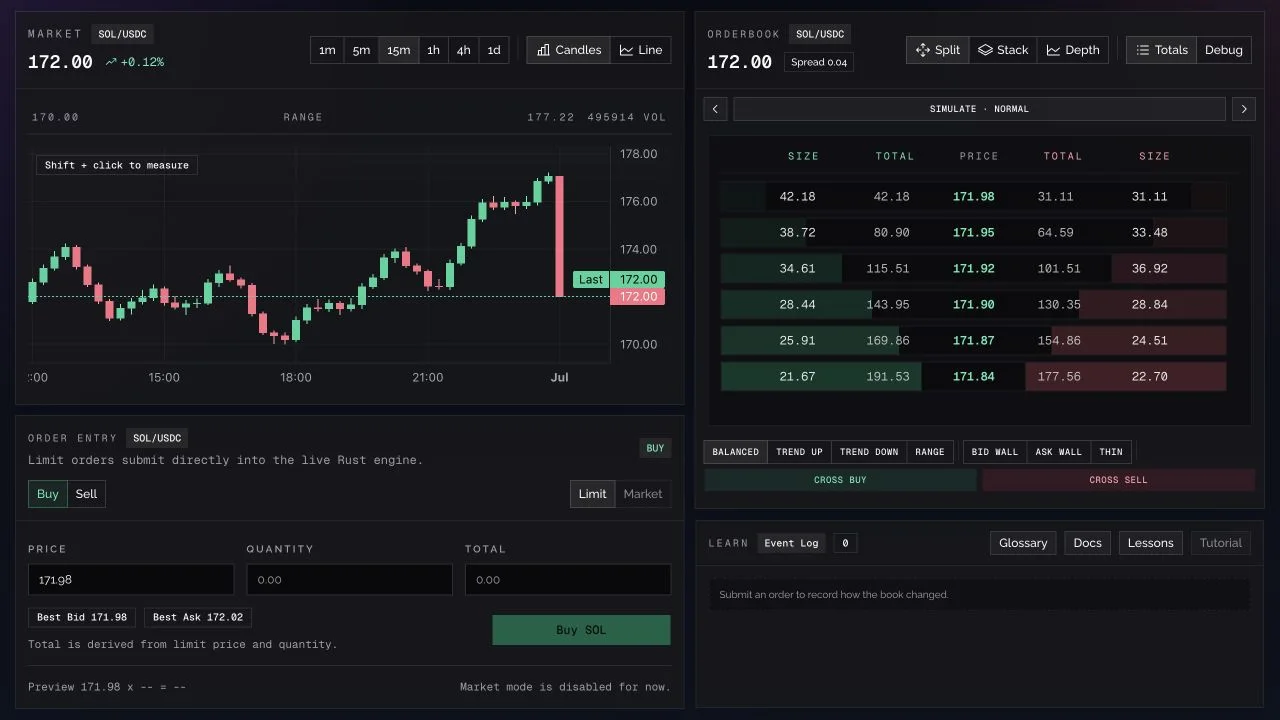
Solbook is an in-memory SOL/USDC order book with exact decimal validation, price-time priority, structured events, deterministic replay, and a web interface for exploring how the engine behaves.
The problem
I wanted to understand order-book behavior through a core small enough to reason about, but strict enough that fills, ordering, and replay could be checked instead of hand-waved.
What I built
- Built typed market rules for prices, quantities, order IDs, validation, and structured errors.
- Implemented limit and market orders, FIFO price-time matching, partial fills, cancellation, snapshots, events, and deterministic replay.
- Added an Axum HTTP adapter and a Next.js learning terminal for submitting orders, changing market scenarios, and inspecting the live book.
Key decisions
- Use exact decimal arithmetic for engine values instead of floating-point amounts.
- Keep the matching engine single-threaded and in memory so ordering stays explicit and deterministic.
- Separate the core library from HTTP, serialization, and UI adapters.
- Use sequence numbers, invariant checks, property tests, benchmarks, and fuzz targets to make behavior measurable.
How I check the work
- Unit, integration, property, replay, serialization, and documentation tests pass with the locked dependency graph.
- Clippy passes across all targets and features with warnings denied.
- Replay tests confirm the same command sequence produces the same events and final book state.